Cyberwarfare and Digital Security: Navigating Global Threats and Defense Strategies
Cyberwarfare represents the intentional deployment of digital attacks by both state and non-state actors, aiming to disrupt, degrade, or coerce adversaries through their networks and information systems. This article delves into the pressing relevance of cyberwarfare today: as connectivity grows, geopolitical tensions rise, and innovative tools like AI and IoT enhance the scale and speed of attacks. Readers will gain insights into the essence of cyberwarfare, the prevalent types of attacks, their effects on critical infrastructure, the workings of national strategies, defensive measures including public-private collaborations, and the technological trends shaping both offense and defense in the near future. Our aim is to provide practical clarity: defining key terms, linking mechanisms to their consequences, and offering actionable guidance for organizations and policymakers striving to mitigate risks. Throughout, we weave in recent patterns and authoritative frameworks, highlighting how information hubs and curated resources bolster ongoing awareness and operational readiness.
What Is Cyberwarfare? Definition, History, and Key Characteristics
Cyberwarfare is a conflict form where actors utilize digital tools and operations to achieve strategic goals against the information systems, infrastructure, or data of their adversaries. At its core, cyberwarfare exploits networks, software vulnerabilities, and human behavior to create outcomes such as disruption, espionage, or coercion; understanding this landscape allows for prioritizing defenses based on intent, target, and capability. Historically, incidents have evolved from opportunistic hacks to organized, persistent operations with political objectives, shaping how states and organizations prepare. Recognizing these characteristics helps differentiate state-level operations from criminal cybercrime and underscores the complexities of attribution, scale, and hybrid tactics in response efforts.
- Strategic intent distinguishes cyberwarfare from profit-driven cybercrime: state objectives often encompass coercion, espionage, or military advantage.
- Scale and persistence: nation-level campaigns can sustain long-term operations across various vectors and targets.
- Attribution challenges: obfuscation and proxy actors complicate legal and diplomatic responses.
These defining traits lead us directly into the evolution of cyberwarfare over time and the significance of historical milestones for current defenses.
How Has Cyberwarfare Evolved Over Time?
Initially, digital intrusions were often exploratory or financially motivated, but by the late 2000s, state-sponsored campaigns showcased how cyber operations could fulfill military and political objectives. Key events marked shifts: from denial-of-service nuisances to sophisticated supply-chain compromises and operational technology intrusions, reflecting expanding goals and capabilities. Recent years (2022–2025) have witnessed campaigns that blend information operations, ransomware as a coercive tool, and AI-assisted reconnaissance, signaling a transition toward more integrated hybrid operations. These trends highlight the necessity for cross-domain defenses that merge technical controls, intelligence sharing, and diplomatic tools.
This chronological evolution sets the stage for examining the main features that operationally and legally distinguish cyberwarfare, which in turn informs practical mitigation strategies.
What Are the Main Features That Distinguish Cyberwarfare?
Cyberwarfare typically involves persistent access attempts, targeting critical systems, and a mix of espionage, disruption, and information influence to achieve strategic objectives. Mechanisms include long-term infiltration by advanced persistent threats (APTs), exploitation of supply chains to broaden reach, and coordinated campaigns that merge digital attacks with kinetic or diplomatic pressure. The repercussions often extend beyond technical damage to include political coercion, economic harm, and diminished public trust, necessitating responses that blend technical remediation with legal, diplomatic, and policy actions. Recognizing these features clarifies priorities such as fortifying operational technology, safeguarding supply chains, and investing in attribution and deterrence capabilities.
Understanding these distinguishing features naturally leads us to a focused exploration of the specific attack types commonly employed in global cyberwarfare.
What Are the Most Common Types of Cyber Attacks in Global Cyberwarfare?
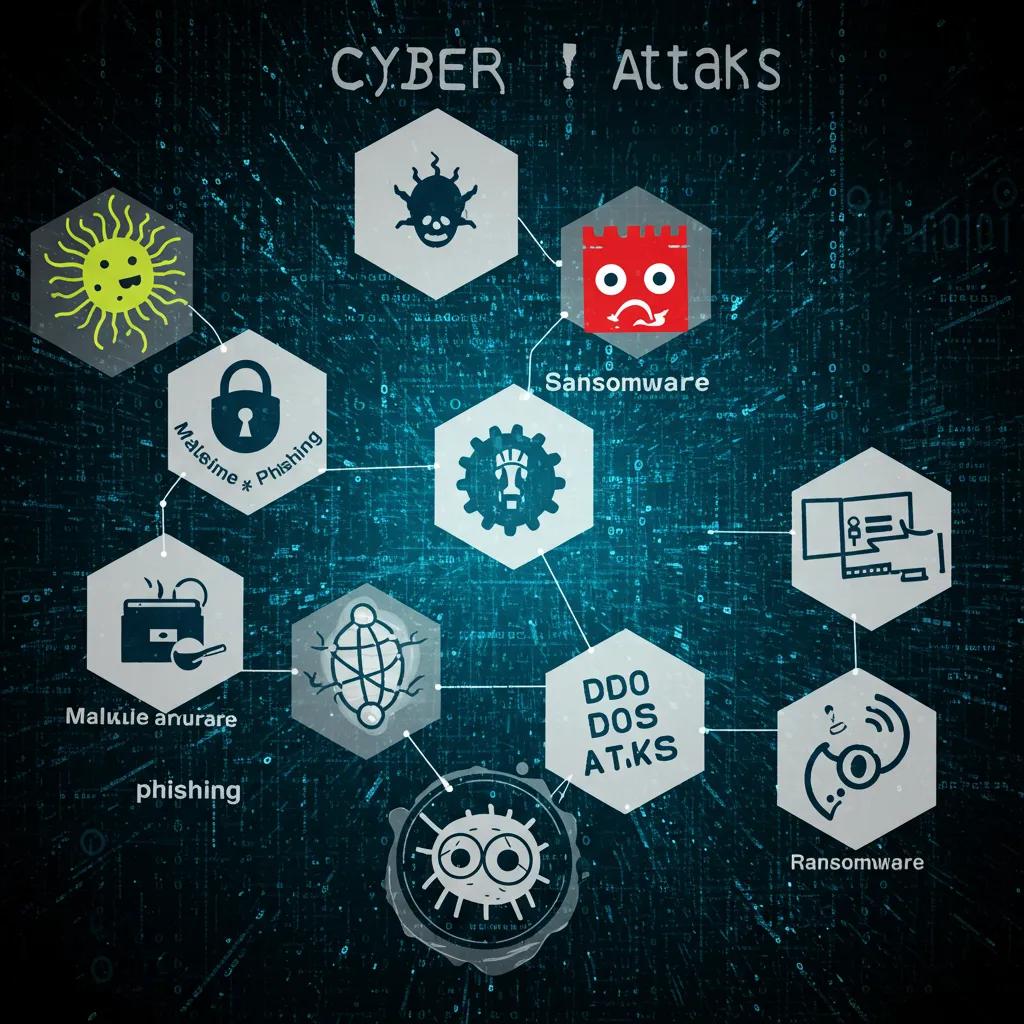
Common cyberwarfare attack types encompass malware families, ransomware used for disruption or funding operations, distributed denial-of-service (DDoS) attacks aimed at availability, phishing for initial access, supply-chain attacks that compromise trusted vendors, and advanced persistent threats (APTs) that maintain long-term access. Each mechanism yields distinct impacts—data exfiltration, operational downtime, physical disruption of OT/ICS, or reputational damage—so mapping attack types to likely targets aids in prioritizing mitigations. A concise enumeration helps defenders and policymakers concentrate on the most consequential vectors and adapt detection and resilience investments accordingly.
The primary attack types and their brief mechanisms are:
- Malware attacks: Malicious software executing unauthorized actions on compromised hosts, ranging from data theft to sabotage.
- Ransomware attacks: Encryption or extortion operations that deny access and pressure victims for payment or concessions.
- DDoS attacks: High-volume traffic or resource exhaustion disrupting the availability of services and infrastructure.
- Phishing attacks: Social-engineering campaigns tricking users into revealing credentials or executing malicious code.
- Supply-chain attacks: Compromise of vendors or software updates to propagate trust-based access into numerous victims.
- Advanced Persistent Threats (APTs): Stealthy, long-term intrusions designed for sustained espionage or strategic manipulation.
These types correlate with attack mechanisms and typical impacts, summarized below for quick comparison.
This comparison clarifies which mechanisms yield which consequences and assists teams in aligning controls to the most probable outcomes.
How Do Malware, Ransomware, and Phishing Attacks Work?
Malware functions by executing unauthorized code on systems, often delivered through exploit kits, malicious attachments, or compromised files, resulting in impacts ranging from data exfiltration to system sabotage. Ransomware typically follows a lifecycle: initial access (often via phishing or vulnerability), lateral movement, encryption or data theft, and ransom demand, with recovery necessitating containment, backups, and forensic analysis. Phishing exploits human trust through deceptive emails, messages, or fake portals that capture credentials or prompt risky actions; training, multi-factor authentication, and email filtering can significantly reduce success rates. These mechanisms underscore the combined technical and human defenses essential for interrupting attack lifecycles and minimizing damage.
Understanding how these attacks operate points directly to emerging vectors—AI-assisted attacks and IoT/OT vulnerabilities—that alter scale and detection requirements.
What Are Emerging Cyber Attack Vectors Like AI-Powered and IoT Threats?
AI-assisted attacks enhance reconnaissance and automate personalized social-engineering, enabling high-volume, adaptive phishing and vulnerability discovery at scale. IoT and OT devices broaden the attack surface by introducing poorly maintained, rarely patched systems into critical operational networks, heightening the risk of physical disruption and cascading failures. Together, AI and IoT amplify both speed and reach: adversaries can identify and exploit weak devices more swiftly while AI-generated content facilitates more convincing deception. Mitigations include model hardening, anomaly-based detection, strict network segmentation, and lifecycle management for connected devices to limit brute-force and automated exploitation.
These emerging vectors heighten the urgency surrounding national resilience and sectoral protections, which we will explore next in terms of infrastructure impacts and economic consequences.
How Does Cyberwarfare Impact National Security and Critical Infrastructure?
Cyberwarfare poses a significant threat to national security by targeting the digital foundations of critical infrastructure—energy, finance, healthcare, transportation—where disruptions can lead to cascading social, economic, and political repercussions. The mechanism often involves focused attacks on OT/ICS components or service providers, whose failures ripple through supply chains and public services; understanding these impacts is crucial for prioritizing defensive resources in high-consequence sectors. Effective assessments map sectors to vulnerabilities and consequences, enabling policymakers to invest in detection, redundancy, and rapid recovery to mitigate systemic risk.
Critical infrastructure sectors, their vulnerabilities, and potential consequences are outlined below for clarity and operational planning.
This sector mapping makes the impacts on national security tangible and indicates where resilience investments will yield the highest returns.
Why Is Critical Infrastructure a Primary Target in Cyberwarfare?
Critical infrastructure offers high leverage because disruptions can create immediate societal and economic pain, amplify political pressure, and serve as coercive tools short of kinetic conflict. Attackers exploit interdependencies—such as power affecting healthcare and communications—to maximize systemic disruption with relatively low-cost digital operations. Operational Technology (OT) systems often lack regular patching, utilize legacy protocols, and expose physical processes, rendering them attractive yet fragile targets; addressing these vulnerabilities necessitates coordinated technical, regulatory, and operational actions. Recognizing infrastructure as a primary target emphasizes the need for cross-sector contingency planning, redundant controls, and prioritized intelligence sharing.
Understanding targeted motives and vulnerabilities sets the stage for analyzing the broader economic and geopolitical consequences that follow major cyber incidents.
What Are the Economic and Geopolitical Consequences of Cyber Attacks?
Major cyber incidents incur direct costs—restoration, lost revenue, ransom payments—and indirect costs such as reputational damage, diminished market confidence, and long-term investment deterrence. Geopolitically, significant operations can trigger sanctions, reciprocal measures, and accelerated militarization of cyber capabilities, heightening the risks of escalation and miscalculation between states. Cyber incidents also erode public trust in institutions and critical services, complicating emergency response and recovery efforts. Quantifying these consequences informs policy decisions: investments in prevention and resilience can be justified by the systemic losses avoided and the reduced likelihood of destabilizing escalation.
These impact dynamics drive national strategies that organize prevention, detection, response, resilience, and international cooperation, which we will examine next.
What Are National Cybersecurity Strategies and How Do They Protect Against Cyberwarfare?
National cybersecurity strategies outline key pillars—prevention, detection, response, resilience, and international cooperation—and translate them into policies, agency roles, and resource allocation to minimize vulnerability and enhance recovery capacity. The mechanism involves aligning legal frameworks, standards, and operational capabilities such as national CERTs and incident response teams to facilitate predictable, coordinated actions during events; the benefit is a clearer risk posture and faster, more unified incident management. Effective strategies also incorporate incentives for private-sector fortification, mandatory reporting, and investments in workforce and technology to bridge capability gaps. Agencies that typically play pivotal roles include national cybersecurity centers, standards bodies, and critical-infrastructure regulators.
The following table compares strategic pillars, objectives, and typical measures used in national strategies to make implementation choices more tangible.
This comparison aids policymakers in prioritizing which measures to operationalize first based on national risk profiles.
For implementers seeking practical steps, curated implementation guides, accredited training courses, and vendor resources can accelerate capacity-building. To support ongoing coverage and resource curation, information hubs and news blogs aim to provide engaging and useful information, drive traffic, and potentially generate revenue through advertising or affiliate programs; organizations should leverage such curated lists to identify authoritative training and implementation partners while steering clear of unvetted vendor claims. These resource recommendations assist organizations in translating strategy into concrete capabilities like SOCs, tabletop exercises, and sector-specific resilience plans.
What Are the Key Pillars of Effective National Cybersecurity Strategies?
Effective national strategies typically integrate the identification of critical assets, risk-based regulations, continuous monitoring, and clear incident-response roles to minimize friction during crises. Practical measures include mandatory reporting for significant incidents, baseline cybersecurity requirements for critical vendors, and incentives for private-sector investment in secure-by-design practices. Capacity-building—cyber workforce training, simulation exercises, and public awareness campaigns—fortifies the whole-of-society posture. These pillars translate into measurable objectives such as mean time to detect, mean time to recover, and the percentage of sector entities meeting minimum baseline standards.
These strategic pillars align with operational practices like international cooperation and cyber diplomacy, which enhance deterrence and mutual assistance.
How Do International Cooperation and Cyber Diplomacy Enhance Digital Security?
International cooperation fosters shared norms, rapid information exchange, and coordinated responses that elevate the costs of aggressive cyber behavior and mitigate unilateral escalation risks. Mechanisms include joint exercises, cross-border threat intelligence sharing, coordinated sanctions, and legal agreements that streamline mutual legal assistance for cyber investigations. Such diplomacy complements technical measures by establishing political and economic consequences for malicious actors while facilitating joint capacity-building for less-resourced partners. Practical examples include multinational CERT partnerships and regional frameworks that enable faster attribution and collective mitigation.
These cooperative mechanisms lay the groundwork for operational defensive measures and public-private partnerships, which provide the hands-on capabilities necessary for detection and response.
What Are the Best Defensive Measures and Public-Private Partnerships in Cybersecurity?
Operational defenses blend technical hygiene—patching, strong identity controls, segmentation—with advanced capabilities like threat intelligence, endpoint detection and response, and regular backups to minimize damage and expedite recovery. Public-private partnerships (PPPs) enhance capacity by facilitating information sharing, joint exercises, and pooled expertise to defend critical sectors at scale; the primary advantage is faster detection and broader resilience than either sector could achieve independently. Practical programs organize regular drills, shared threat feeds, and coordinated incident handling protocols that align private operational practices with national response frameworks.
Key operational defensive measures that organizations should prioritize include the following list, which supports immediate risk reduction.
- Patch Management and Asset Inventory: Keep an up-to-date inventory and apply prioritized patches to minimize exploitable exposure.
- Network Segmentation and Least Privilege: Restrict lateral movement by isolating critical OT/ICS and enforcing minimal access rights.
- Strong Authentication and Monitoring: Implement multi-factor authentication and continuous logging with alerting to detect suspicious behavior.
- Backups and Recovery Plans: Establish immutable backups and tested recovery procedures to mitigate ransomware impact.
- Threat Intelligence and SOC Integration: Utilize intelligence feeds and integrate with security operations to shorten detection-to-response time.
These defensive measures are most effective within an ecosystem that includes regular exercises and intelligence sharing, as described in the next subsection.
This section includes a brief set of practical examples and a reminder that staying informed and utilizing curated resources enhances preparedness. To assist organizations in finding vetted guidance, information hubs and curated resource lists can direct them to reputable training courses, implementation guides, and vendor evaluations; as part of an ongoing awareness strategy, these hubs aim to provide engaging and useful information, drive traffic, and potentially generate revenue through advertising or affiliate programs, so readers should assess recommendations against independent standards and certifications.
How Do Threat Intelligence and Cybersecurity Drills Improve Defense?
Threat intelligence transforms observed adversary behavior into actionable indicators and tactics, techniques, and procedures that defenders leverage to refine detection and response playbooks; the mechanism involves converting raw logs into prioritized alerts and context for incident handlers. Drills—tabletop exercises, red-team/blue-team engagements, and full-scale simulations—stress-test procedures, uncover communication gaps, and accelerate organizational learning. Regular practice also sharpens metrics for success, such as reducing mean time to detect and enhancing cross-organizational coordination. By merging intelligence-driven detection with rehearsed response, organizations significantly decrease dwell time and downstream impact.
These operational enhancements naturally lead to the discussion of PPPs and how cross-sector collaboration amplifies defensive capabilities.
What Role Do Public-Private Partnerships Play in Strengthening Cybersecurity?
Public-private partnerships facilitate the sharing of threat intelligence, coordinated incident responses, and joint capacity-building that harnesses the strengths of government oversight and private-sector agility. Models include sectoral Information Sharing and Analysis Centers (ISACs), joint exercises simulating national-scale incidents, and shared services that grant SMEs access to SOC capabilities. Benefits encompass improved situational awareness, pooled expertise for complex investigations, and joint investments in resilience. Successful partnerships emphasize clear governance, data-handling agreements, and mutual benefits to ensure sensitive information can be shared without legal or commercial friction.
After reviewing partnership models, we turn our attention to technological trends—AI, quantum, and IoT—that will reshape both offensive and defensive landscapes.
What Is the Future of Cyberwarfare? AI, Quantum Computing, and Emerging Trends

Near-term trends suggest that AI will enhance both detection and offense by enabling automated reconnaissance, faster exploit discovery, and adaptive social-engineering campaigns, while defenders will deploy AI for anomaly detection and response orchestration. Quantum computing presents a medium-term challenge to current cryptographic standards, creating urgency for transitioning to post-quantum cryptography to safeguard long-lived secrets. The proliferation of IoT and increased OT connectivity broaden the attack surface, making device lifecycle management and secure-by-design principles vital for maintaining resilience. Collectively, these trends indicate a future where speed, scale, and automation dominate both attack and defense, underscoring the importance of human oversight and cross-domain cooperation.
Key near-term trends to monitor include:
- AI-Augmented Offense and Defense: Automated exploit discovery and adaptive phishing elevate attack rates while AI-driven detection accelerates response.
- Post-Quantum Cryptography Migration: Preparing for quantum-capable adversaries by adopting quantum-resistant algorithms for critical data.
- IoT/OT Surface Expansion: Widespread device connectivity necessitates lifecycle management, segmentation, and firmware integrity verification.
These trend forecasts imply concrete defensive actions such as investing in AI-savvy incident response, initiating cryptographic transition planning, and enforcing IoT security standards.
How Will AI and Machine Learning Transform Cyber Defense and Offense?
AI bolsters defense by automating anomaly detection, prioritizing alerts, and orchestrating response workflows to alleviate human workload and response times; models learn from telemetry to surface high-risk incidents more swiftly. Offensively, AI can generate convincing deepfakes, craft tailored phishing content, and rapidly identify vulnerabilities, increasing the volume and personalization of attacks. Defensive effectiveness hinges on model governance, adversarial robustness, and human-in-the-loop validation to prevent over-reliance on automated decisions. Organizations should strike a balance between automation and expert oversight, investing in model-security practices to ensure detection systems remain reliable against adversarial manipulation.
Grasping AI’s dual-use nature leads directly to planning for cryptographic and IoT-specific challenges discussed next.
What Challenges Do Quantum Computing and IoT Security Present?
Quantum computing threatens certain asymmetric cryptographic algorithms, necessitating an inventory of cryptographic dependencies, prioritization of high-value key migrations, and adoption of post-quantum standards once they mature. IoT security introduces scalability and lifecycle challenges: billions of devices with limited update mechanisms, diverse vendors, and weak default configurations complicate patching and accountability. Mitigations encompass network-level segmentation, firmware signing, secure boot, and procurement standards demanding updateability and vendor transparency. Policymakers and operators must coordinate timelines, invest in workforce skills, and initiate phased cryptographic transitions to minimize long-term exposure.
As organizations strategize for these challenges, they should leverage curated resources and training to enhance readiness; information hubs and curated guidance can direct them to implementation playbooks and accredited training while operating under sustainable monetization models that support independent coverage and resource curation.
Frequently Asked Questions
What are the key differences between cyberwarfare and cybercrime?
Cyberwarfare is primarily state-sponsored and aims to achieve political or military objectives, such as espionage or disruption of critical infrastructure. In contrast, cybercrime is typically profit-driven, focusing on financial gain through activities like identity theft or fraud. While both involve malicious digital activities, their motivations, targets, and consequences differ significantly. Understanding these distinctions is crucial for developing appropriate defensive strategies and legal responses to each type of threat.
How can organizations prepare for the evolving landscape of cyberwarfare?
Organizations can enhance their preparedness by adopting a multi-layered cybersecurity strategy that includes regular risk assessments, employee training, and incident response planning. Implementing strong access controls, maintaining up-to-date software, and investing in threat intelligence can also help mitigate risks. Additionally, fostering public-private partnerships can provide access to shared resources and expertise, enabling organizations to stay informed about emerging threats and best practices in cybersecurity.
What role does employee training play in preventing cyber attacks?
Employee training is vital in preventing cyber attacks, as human error is often a significant factor in security breaches. Regular training sessions can educate staff about recognizing phishing attempts, using strong passwords, and following security protocols. By fostering a culture of cybersecurity awareness, organizations can reduce the likelihood of successful attacks and empower employees to act as the first line of defense against potential threats.
What are the implications of AI in cyberwarfare?
AI has significant implications for both cyber offense and defense. On the offensive side, adversaries can use AI to automate attacks, enhance phishing campaigns, and discover vulnerabilities more efficiently. Conversely, defenders can leverage AI for anomaly detection, threat intelligence analysis, and incident response orchestration. However, the dual-use nature of AI necessitates careful governance and oversight to ensure that automated systems remain effective and secure against adversarial manipulation.
How do international laws and agreements impact cyberwarfare strategies?
International laws and agreements play a crucial role in shaping cyberwarfare strategies by establishing norms for state behavior in cyberspace. These frameworks can help deter aggressive actions and promote cooperation among nations in addressing cyber threats. However, the lack of universally accepted regulations complicates enforcement and accountability, making it essential for countries to engage in diplomatic efforts to create a cohesive approach to cybersecurity and cyberwarfare.
What are the potential economic impacts of a significant cyber attack?
A significant cyber attack can lead to substantial economic impacts, including direct costs such as restoration expenses, ransom payments, and lost revenue. Indirect costs may involve reputational damage, decreased consumer trust, and long-term investment deterrence. The cascading effects of such incidents can disrupt supply chains, impact critical infrastructure, and strain public resources, highlighting the importance of investing in cybersecurity measures to mitigate these risks.
What steps can governments take to enhance national cybersecurity resilience?
Governments can enhance national cybersecurity resilience by developing comprehensive cybersecurity strategies that prioritize prevention, detection, response, and recovery. This includes investing in critical infrastructure protection, fostering public-private partnerships, and promoting information sharing among stakeholders. Additionally, governments should support workforce development initiatives to build a skilled cybersecurity workforce and engage in international cooperation to address cross-border cyber threats effectively.
Conclusion
Grasping the complexities of cyberwarfare is essential for safeguarding national security and critical infrastructure. By prioritizing effective defensive measures and nurturing public-private partnerships, organizations can bolster their resilience against evolving threats. Staying informed through curated resources and training is vital for maintaining operational readiness in this dynamic landscape. Explore our comprehensive guides and resources to empower your cybersecurity strategy today.